Restoring form and function - Restauration de la forme et de la fonction
Open Fasciectomy for Dupuytren’s Disease
Open fasciectomy is a surgical procedure performed to treat Dupuytren’s disease in the palm and fingers, causing them to bend inward over time.
HAND SURGERYRAMQ - FUNCTIONAL
Dr. Becher Alhalabi
3 min read
1. What Is Open Fasciectomy for Dupuytren’s Disease?
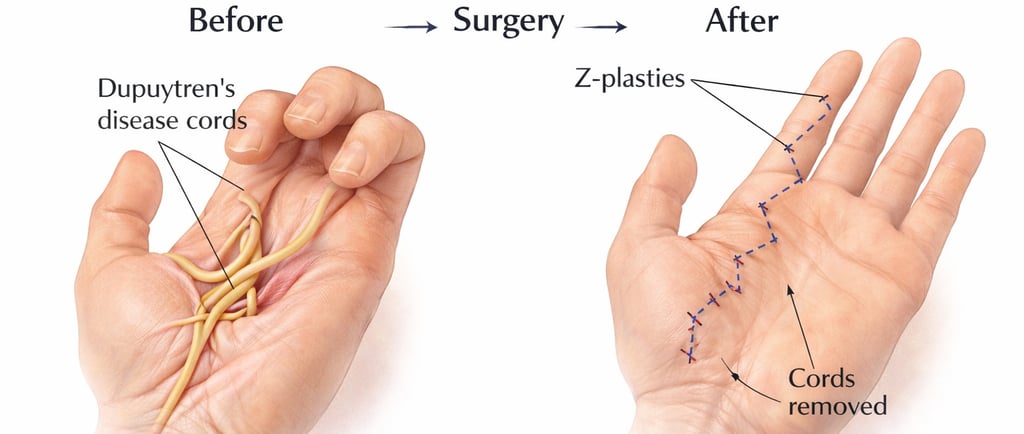
Open fasciectomy is a surgical procedure performed to treat Dupuytren’s disease, a condition in which abnormal fibrous tissue (Dupuytren’s cords) forms in the palm and fingers, causing them to bend inward over time. It is a benign (non-dangerous), progressive (worsens with time), inflammatory condition (related to injury and inflammation).
The goal of surgery is to remove the diseased tissue and improve finger extension, hand function, and daily activities.
This procedure is typically recommended when finger contractures interfere with hand use or quality of life. Open fasciectomy is usually performed as a day surgery, and most patients go home the same day.
2. How the Procedure Works
Before Surgery
You will meet with your surgeon to confirm the diagnosis and review which fingers are affected. You will receive instructions regarding:
· Medications to stop or continue
· Recovery and time needed off work
· Any special issues related to your healing if you have certain conditions (diabetes, smoking, vascular disease, etc)
During Surgery
· The procedure is performed under regional or local anesthesia, depending on the extent of surgery and patient factors.
· One or more incisions are made in the palm and/or fingers in a zigzag manner to allow for them to elongate.
· The abnormal Dupuytren's tissue (cords) is carefully removed while protecting nerves, blood vessels, and tendons.
· The fingers are gently straightened.
· The incisions are closed with sutures (which may or may not be dissolving).
· A dressing and sometimes a splint are applied.
· Surgery duration varies but typically lasts ½ -1 hour, depending on complexity.
After Surgery
· You will be monitored briefly in the recovery area before discharge.
· Your hand will be wrapped in a bulky dressing, and a splint may be applied.
· Pain is usually moderate and managed with prescribed or over-the-counter pain medication. Antibiotics may be given.
· Elevation of the hand is very important in the early recovery period.
3. Postoperative Expectations
· Swelling of the hand and fingers
· Bruising
· Pain or tightness
· Temporary stiffness
· Reduced grip strength initially
Recovery after Dupuytren's surgery is gradual and often requires hand therapy to optimize results.
Phase 1: Immediate Care (From Surgery Until First Follow-Up Appointment)
· Keep your dressing clean and dry.
· Watch for signs of infection (increasing redness crawling up the arm, swelling, warmth, drainage, limited hand mobility or fever).
· Your first follow-up appointment is usually scheduled 2-5 days after surgery for wound check and dressing changes with the CLSC. This will last for 2 weeks or until taken over by the therapist. Suture removal may happen at 10-14 days if you had non-dissolving sutures.
· Your first follow up with the therapist is usually within 1-2 weeks for exercises and splint making. Please start exercising before seeing the therapist.
· If you had dissolving sutures, your first follow-up appointment with Dr. Alhalabi is usually scheduled 4-6 weeks after surgery.
· Dissolving sutures melt as your body absorbs them by inflammation. It is normal that your skin becomes red around the sutures, with possible white liquid from the suture holes. This is your body dissolving the sutures and you need to help it by rubbing the sutures with clean water.
Phase 2: Early Recovery (Up to 6 Weeks Post-Surgery)
· Swelling and discomfort gradually decrease.
· Light daily activities may be resumed as tolerated.
· Stitches are removed if not absorbable.
· You may be advised to begin gentle hand and wrist exercises.
· Avoid forceful gripping, heavy lifting, or prolonged pressure on the palm.
· A custom night splint may be prescribed.
Phase 3: Long-Term Recovery (6 Weeks and Beyond)
Finger motion and strength continue to improve over several months. Scar care is introduced:
· Scar massage
· Moisturizing creams
· Silicone sheets or gels if recommended
· Hand therapy may continue depending on progress.
Return to full activities depends on job demands and recovery. It is important to understand that Dupuytren's disease can recur, even after successful surgery.
4. Risks and Possible Complications
Open fasciectomy is effective but carries some risks, including:
· Infection
· Bleeding or hematoma
· Delayed wound healing
· Scar tenderness or sensitivity
· Stiffness or reduced finger motion
· Nerve or blood vessel injury
· Persistent pain
· Recurrence of Dupuytren's disease
· Need for additional surgery or prolonged therapy
5. Alternatives and Other options
Depending on disease severity and finger involvement, alternatives may include:
· Observation for mild, non-limiting disease
· Needle aponeurotomy
· Enzyme injection (collagenase) – Outside Canada
· Radiation therapy
Each option has different risks, benefits, and recurrence rates, which should be discussed with your surgeon. If you are unsure about the procedure or have further questions, you are encouraged to book an additional pre-operative appointment. You always have the right to seek a second opinion—please let us know if you wish to do so.